What beard suits your face shape
A beard does two measurable things: it makes the face longer and the jaw wider. Every piece of beard advice worth having comes from deciding whether you want either.
Last reviewed 2 September 20267 min readSravya
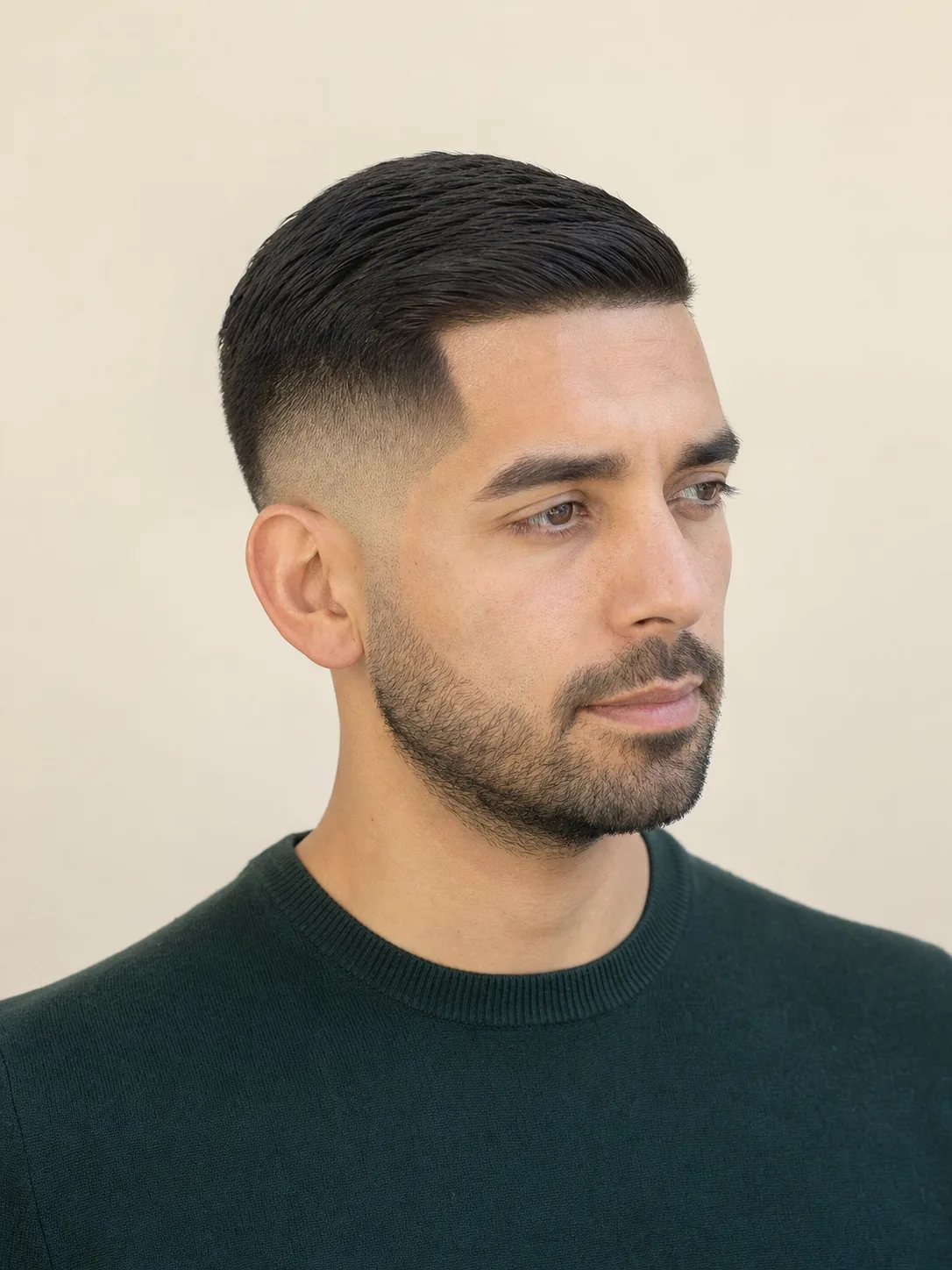
- 0.72
- The narrowest jaw of the seven
- 1.58
- The longest face of the seven
- 1.02
- The only jaw wider than the cheekbones
heart shape, jaw against cheekbone width, where a beard does the most
oblong, length against cheekbone width, where extra length works against you
triangle, where a full beard widens the part that is already widest
The short answer
A beard lengthens the face and widens the jaw, so the right one depends on whether your face needs either. A narrow jaw and a short face, which is round or heart or diamond, gains from a beard with length at the chin and tight sides. A long face gains from the opposite: short at the chin, fuller at the sides. A jaw that is already the widest part of your face, which is the triangle shape, is the one case where a full beard makes the imbalance stronger rather than correcting it.
01The two things a beard measurably does
Strip away the styling language and a beard changes two numbers. It extends the bottom of the visible face, which makes the face read longer. And it adds bulk at the sides of the jaw, which makes the lower face read wider. Every other effect is texture.
Those two numbers happen to be the ones this site measures. Face length against cheekbone width runs from 1.06 on a round face to 1.58 on an oblong one. Jaw width against cheekbone width runs from 0.72 on a heart face to 1.02 on a triangle. Once you know roughly where you sit on both, the beard decision answers itself.
02Every beard against every face shape
| Face shape | What the numbers say | What works | What fights you |
|---|---|---|---|
| Round | Short face at 1.06, soft jaw at 0.88 | Length at the chin with the sides kept short. A goatee, a ducktail, a short boxed beard taken tight at the cheeks | Full round beards and mutton chops, which add width where there is already width |
| Square | Short face at 1.10, strong jaw at 0.97 | A short, close beard that follows the jaw, or a light stubble. Some length at the chin if you want the face longer | Heavy sides and a squared-off bottom, which double an already square outline |
| Oval | Balanced at 1.38 and 0.82 | Almost anything. This is the shape that carries a full beard, stubble and a goatee equally well | Nothing structural. Choose on hair density and upkeep instead |
| Oblong | Long face at 1.58 | Fullness at the sides and cheeks, kept short under the chin. A short full beard or a chin strap with volume at the jaw | Goatees, long chin beards and anything pointed, which lengthen a face that is already the longest of the seven |
| Heart | Wide forehead at 1.00, narrow jaw at 0.72 | The best case for a full beard on the whole list. Volume at the jaw balances the widest forehead of the seven | Bare chin styles like a moustache alone, which leave the narrowest part of the face exposed |
| Diamond | Narrow forehead at 0.78, narrow jaw at 0.74 | A full beard that adds width low down, kept from getting pointed at the bottom | Pointed or tapered chin beards, which sharpen a chin that already tapers |
| Triangle | Jaw at 1.02, wider than the cheekbones | Short, tight beards that follow the jaw without adding bulk. Stubble is genuinely the strongest option here | Full beards and anything squared at the sides, which widen the widest part of the face |
Ratios are the published profile centres this site classifies against, expressed as fractions of cheekbone width. Suitability is proportion reasoning of the same kind the tools use, not a rule. Beard density decides more than face shape does: a patchy growth pattern rules out a style no matter what the numbers say.
03The shape that gains most, and the one that gains least
The heart face has the widest forehead of the seven at 1.00 of cheekbone width and the narrowest jaw at 0.72. That is a gap of 0.28 between the top and the bottom of the face, the largest on the list. A full beard closes it, and there is no other styling decision available that closes it as much in one move.
The triangle face is the reverse. Its jaw is 1.02 of cheekbone width, the only one of the seven where the jaw is wider than the cheekbones. Adding beard bulk at the sides makes the widest part wider. That is the one case where the popular advice to grow a full beard is actually working against the face wearing it.
The oval face gains nothing structural because there is nothing to correct at 1.38 length and 0.82 jaw. That is not a limitation. It means the choice can be made on hair density, growth pattern and how much daily maintenance you are prepared to do, which are the factors that decide whether a beard actually gets kept.
04What the neck line does, which nobody mentions
Where the beard stops underneath matters more to how the jaw reads than the length at the chin does. Taken too low, down the neck, the jaw line disappears and the face reads wider and heavier regardless of shape. Taken too high, along the jaw bone itself, the face reads shorter.
The usual guidance is to find the point two fingers above the Adam's apple and curve the line from there up toward the back of each ear. That single decision does more for a square or triangle face than choosing between beard styles does.
The cheek line is the other one. Left to grow, it climbs and widens the middle of the face. Cleaned to a line running from the sideburn to the corner of the mouth, it keeps the width at the jaw where it was wanted.
Common questions
Sources
Every figure quoted above is listed here with what it was used for and when the source was last checked. Anything not attributed to a source is this site’s own reading and is labelled as such where it appears.
Braun
How to trim and shape the perfect beard necklineWhere the beard neck line should sit, two fingers or about 1.5 inches above the Adam's apple, and the curve running toward the lowest point of each ear.
Last checked 2026-09-02
Matrix
How To Choose The Best Hairstyle For Your Face ShapeThe seven face shape definitions each beard recommendation is paired against, including which profiles read long and which read wide.
Last checked 31 July 2026
Check it against your own measurements
The tool prints your jaw against cheekbone width under the result, which is the single number that decides whether a beard should add width or avoid it.
Measure your jaw ratio