Do you have a square jaw?
Jaw width divided by cheekbone width. A square profile sits near 0.97, an oval near 0.82. That one number answers the question better than any photo comparison.
Last reviewed 18 August 20265 min readSravya
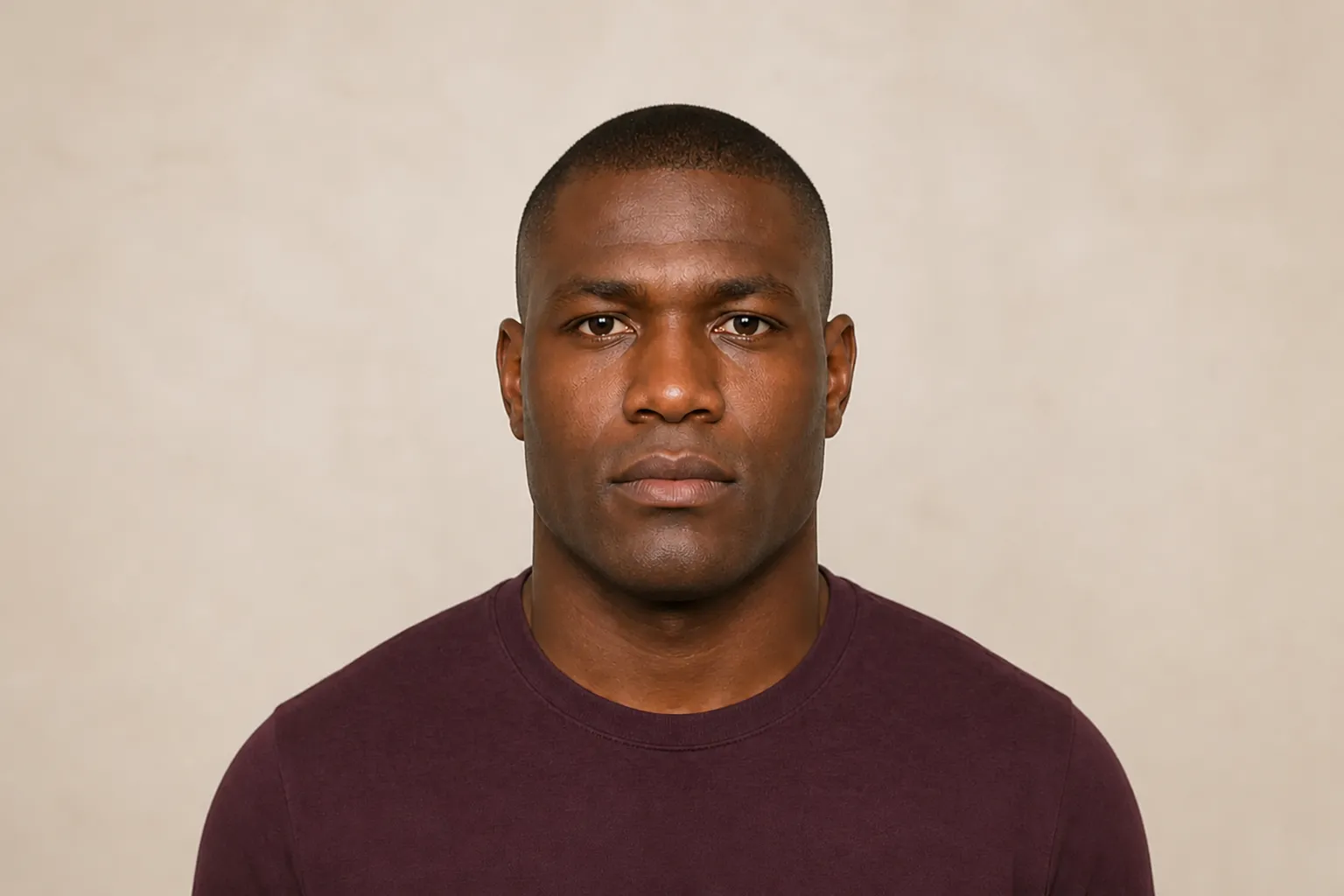
- 0.97
- Square jaw ratio
- 0.72
- The narrowest jaw
- 0.25
- The whole range
jaw width divided by cheekbone width on the square profile
the heart profile, for contrast
every face shape sits between 0.72 and 1.02
The short answer
Measure the width across your jaw at its widest, then across your cheekbones at their widest, and divide the first by the second. Near 0.97 or above reads as a square jaw. Near 0.82 does not. That is the entire test, and it takes a tape measure and thirty seconds.
01A square jaw is a ratio, not a look
Almost every article on this subject asks you to compare your face to a photograph of someone else's. That does not work, because a jaw only reads as square relative to the face around it. A wide jaw under wider cheekbones reads tapered. The same jaw under narrower cheekbones reads square. The absolute width tells you nothing on its own.
So the useful measurement is a proportion: jaw width divided by cheekbone width. It removes head size from the question entirely, which is why the same figure works whether you have a large head or a small one.
- 1Pull your hair back and stand square to a mirror, with your eyes level. Tilting the head changes apparent jaw width more than most people expect.
- 2Measure straight across the face at the jaw angles, the corners below and slightly forward of your ears. Not around the jaw, across it.
- 3Measure straight across the cheekbones at their widest point.
- 4Divide the jaw measurement by the cheekbone measurement. A number near 0.97 or above is a square jaw; near 0.82 is a tapered one.
02Where every face shape sits
| Face shape | Jaw ÷ cheek | What that means |
|---|---|---|
| Triangle | 1.02 | The jaw is actually wider than the cheekbones |
| Square | 0.97 | Jaw and cheekbones near equal, with an angular corner |
| Round | 0.88 | Near-equal widths, but the corner is soft rather than angular |
| Oblong | 0.84 | Moderate taper on a face that is long overall |
| Oval | 0.82 | A gentle, gradual narrowing below the cheekbones |
| Diamond | 0.74 | Narrow at both the brow and the jaw |
| Heart | 0.72 | The strongest taper, running to a defined point |
These are the same profile figures the face shape tool compares your measurements against. They are editorial thresholds for a repeatable nearest-profile comparison, not anthropometric norms.
03Square jaw and square face are not the same thing
This is the part most people are actually asking about without realising it. A square face needs two things at once: a jaw close in width to the cheekbones, and a face that is not much longer than it is wide. The square profile sits at 1.10 for length against cheekbone width, which is close to square in the literal sense.
You can have a square jaw on a face that is not square. A triangle face has the widest jaw of all seven profiles at 1.02, wider than square, but it runs longer at 1.16 and narrows at the brow, so the overall outline is not square. An oblong face can carry a fairly strong jaw at 0.84 and still read long rather than square, because length dominates.
04What the number does not tell you
Being a few hundredths away from a figure in that table means nothing. The gap between round at 0.88 and oblong at 0.84 is smaller than the error introduced by measuring at slightly the wrong height on the jaw. Being a long way from one of them is what matters.
It also says nothing about whether a square jaw is desirable, because that is not a question with an answer. It is a proportion, the same way height is a proportion. This site measures it so that styling choices can be made from something real rather than from guesswork, and for no other purpose.
Nothing here is medical, and this site does not cover exercises, jaw training or surgery. Those are health questions and they belong with a qualified professional, not a styling tool.
Common questions
Sources
Every figure quoted above is listed here with what it was used for and when the source was last checked. Anything not attributed to a source is this site’s own reading and is labelled as such where it appears.
Matrix
How To Choose The Best Hairstyle For Your Face ShapeThe qualitative definitions the seven profiles are built from, including the square profile carrying forehead, cheekbone and jaw widths that are close to each other.
Last checked 31 July 2026
All Things Hair
How Do I Determine My Face Shape?The measuring method this article describes, taking jaw and cheekbone width at their widest points, and the descriptions separating a wide jaw from a long face.
Last checked 31 July 2026
WhatSuitsMe
Face shape ratio profilesEvery jaw to cheek figure quoted here is read from src/data/face-shape-data.ts, the same table the tool classifies against, so the article and the tool cannot drift apart.
Last checked 19 August 2026
Check it against your own measurements
The face shape tool works out jaw against cheekbone from a photo, a tape measure or three questions, and shows you the figure rather than just a label.
Measure your jaw ratioRead next
- Square face shapewhen the jaw and the whole outline are both square
- Triangle face shapethe profile with the widest jaw of all seven
- Necklines by face shapewhat to wear below a jaw once you know its shape
- How to Measure Your Face ShapeEvery face shape tool claims to measure your face and then shows you a word. This is the measuring itself: where the tape goes, which four numbers matter, and the ratios each shape sits at.