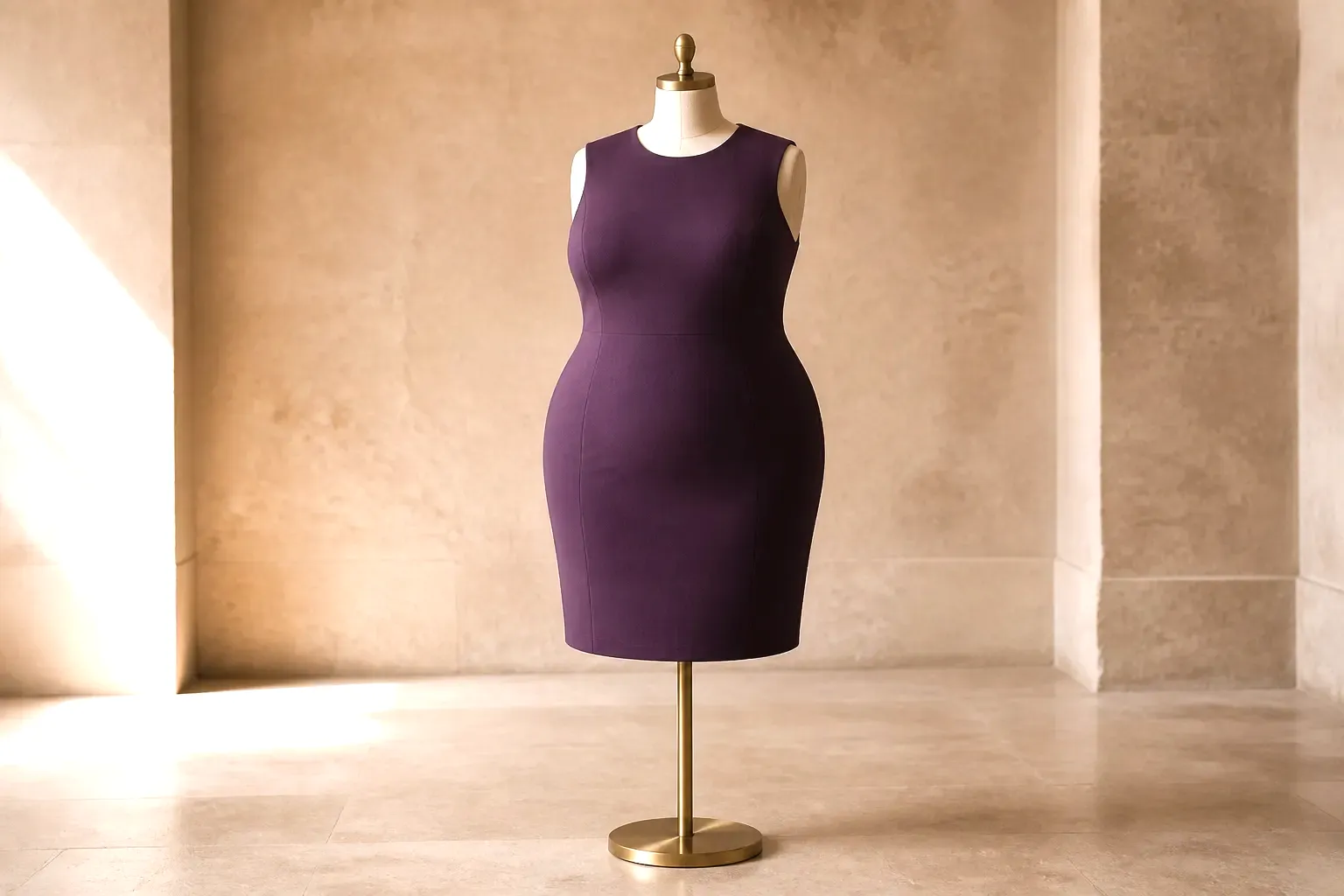
These are editorial ratio centres for a nearest-profile comparison, not medical categories or size charts. The calculator measures how far your two ratios sit from each of the five centres and reports the closest, along with how close the runner-up came.
An apple, sometimes called a round or oval shape, carries weight through the middle, so the waist measures close to the hip rather than well below it. The bust is often the widest measurement of the three, and the outline runs fairly straight from bust to hip without a marked narrowing between them.
This is a clothing category and nothing more. The word apple also appears in health writing about where body fat is carried, and that is a separate subject with separate evidence behind it. Nothing on this page is health advice, and a body shape label says nothing about anyone's health.
How to measure yours
Measure the waist at its narrowest point, not at the navel and not at the widest point of the stomach. On this shape the narrowest point can be quite high, just under the ribs, and measuring lower will overstate the figure.
Measure the bust at the fullest point and the hip at its fullest. Divide waist by hip. An apple sits near 0.94, meaning the waist is within about six percent of the hip measurement.
If the waist comes out closer to 0.84 with a balanced bust and hip, the shape is reading rectangle. The gap between the two is small, so measure carefully and do not pull the tape tight.
Rectangle sits near 0.84 waist to hip, apple near 0.94. The two are close enough that tape tension and where you take the waist measurement can move you between them.
An inverted triangle has a much wider bust relative to hip, near 1.14 against 1.02, and a more defined waist near 0.82.
The principle behind every suggestion below
There is little natural narrowing between bust and hip, so the useful moves build a long uninterrupted vertical line and let fabric skim the middle rather than grip it or hang loose from it.
Clothes
The two failure modes pull in opposite directions. Something tight through the middle maps every contour, and something shapeless hangs from the widest point and adds width. What works sits between the two: fabric that touches the body without clinging.
Worth reaching for
Open necklines, which draw the eye up and create vertical length
Tops that skim the torso without gripping the waist
Straight or gently flared trousers, which continue the line downward
Single-breasted layers and dresses with soft vertical seams
Works against it
Anything tight and clinging through the middle
Shapeless, tent-like cuts that hang straight from the bust
Wide horizontal detail, waistbands or belts sitting at the fullest point
Double-breasted jackets, which add a second horizontal block across the torso
The single most useful move
Wear a long open layer that runs unbroken from shoulder to below the hip.
An open cardigan, waterfall jacket or long unbuttoned shirt creates two continuous vertical lines down the body. It does more for the outline than any amount of choosing between necklines, and it works over almost anything.
Where people go wrong
Measuring the waist at the navel
On this shape the narrowest point is often several inches higher, just below the ribs. Measuring at the navel or at the fullest point inflates the ratio and can misplace the shape.
Reaching for a shapeless cut through the middle
Fabric that hangs straight from the bust makes the whole torso read at that width. Something that skims the body gives a narrower outline than something that tents over it, which is counterintuitive and consistently true.
Reading a styling label as a health statement
The apple and pear terms also appear in health writing about fat distribution. That is a different subject with different evidence. A clothing shape label carries no information about anyone's health.
Common questions
Usually not at the natural waist, because it draws a horizontal line across the fullest part and interrupts the vertical line that helps most. A belt worn higher, just under the bust, can work because it sits above the widest point rather than on it.
Only the waist figure, and the gap is narrow. A rectangle sits near 0.84 waist to hip and an apple near 0.94. Because the two are close, measuring at the wrong height or pulling the tape tight can move you from one to the other, so it is worth measuring twice.
They add vertical length at the top of the outline, which is the direction that helps on this shape. The effect is real but modest. A long open layer running the full height of the body does considerably more, and the two work well together.
Measurement points, proportional shape comparisons and optional clothing effects.
Last checked 2026-07-31
Not sure this is you?
The calculator compares your two ratios against all five profiles and shows how close the runner-up was, which matters because most people sit between two rather than squarely on one.